
- The ICMR Formula Everyone Should Know
- But What If You’re Not Sedentary?
- Why Most Indian Vegetarian Diets Fall Short
- The Indian Vegetarian Protein Powerhouses
- The Cereal-Pulse Combination You Already Know
- Can You Actually Hit 100 Grams Without Supplements?
- Common Myths That Need to Die
- Making It Work in Real Life
- Frequently Asked Questions
You’ve probably heard someone say that vegetarian Indian diets don’t have enough protein. Or maybe you’re tracking your meals and wondering if those dal-rotis actually cut it. Here’s the deal: most Indians—vegetarian or not—are eating way less protein than they should. But the question isn’t just about hitting some random number. It’s about figuring out your actual needs based on your body, lifestyle, and goals. And yes, you can absolutely meet those needs with traditional Indian vegetarian foods.
Let’s break down exactly how much protein a vegetarian Indian actually needs, using real guidelines—not gym bro science.
The ICMR Formula Everyone Should Know
The Indian Council of Medical Research (ICMR) recommends 0.83 grams of protein per kilogram of body weight for healthy adults. That’s the baseline.
Do the math: if you weigh 60 kg, you need about 50 grams of protein daily. A 70 kg person? Around 58 grams.
Sounds simple, right? Thing is, most people don’t actually know how much protein they’re eating. That bowl of dal you had for lunch? Probably gave you 6-8 grams. Two rotis? Maybe 5-6 grams combined. You see where this is going.
Why 0.83 Grams Per Kg?
According to Rebalance Kitchen’s breakdown of ICMR guidelines, this number accounts for the fact that plant proteins have slightly lower digestibility than animal proteins. So vegetarians need that little bit extra to compensate. Makes sense when you think about it.
But What If You’re Not Sedentary?
That 0.83 g/kg figure? It’s for people with average activity levels. Desk job, occasional walk, nothing crazy.
Work out regularly? You’re looking at 1.0 to 1.4 grams per kg. Hit the gym hard and trying to build muscle? Studies suggest 1.4 to 1.8 grams per kg of lean body mass is the sweet spot for strength training.
Let’s be real—if you’re doing intense workouts four times a week, your protein needs aren’t the same as someone who walks 20 minutes daily.
Special Cases That Change Everything
Pregnant? Add about 23 grams daily to your baseline. Breastfeeding mothers need an extra 13.7 grams in the first six months.
Over 60? Your body needs more protein to prevent muscle loss—aim for 1.0 to 1.2 grams per kg even if you’re not super active.
Why Most Indian Vegetarian Diets Fall Short
Honestly? The typical Indian plate is carb-heavy. Rice, roti, rice, more roti. NDTV points out that many Indians consume significantly less protein than recommended, especially vegetarians who rely heavily on cereals.
One bowl of dal isn’t going to save you.
Think about yesterday’s meals. Did you have protein at breakfast? Or was it just poha or upma? Lunch—was there actual dal or chickpeas, or mostly sabzi and roti? These gaps add up fast. Planning an effective indian vegetarian protein diet requires being intentional about every meal, and understanding how traditional protein diet indian food choices stack up against your daily requirements.
The Indian Vegetarian Protein Powerhouses
Good news: Heritage Hospitals lists tons of vegetarian options that pack serious protein. You don’t need fancy imported foods.
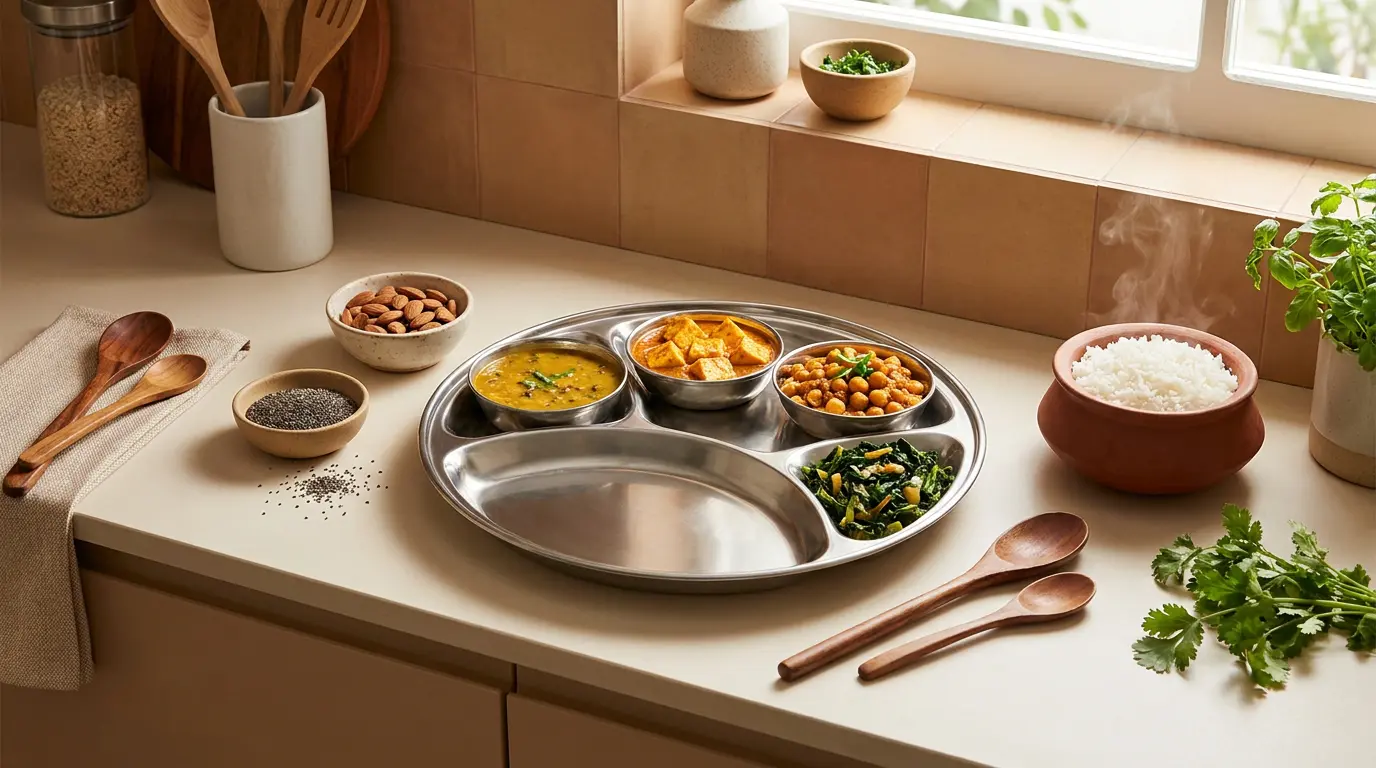
- Dal and legumes: Moong, masoor, toor, chana—all give you 6-9 grams per cooked cup
- Paneer: 100 grams = roughly 18 grams protein
- Dahi (Curd): 1 cup = 10-12 grams protein
- Soya chunks: 50 grams dry = about 25 grams protein (seriously underrated)
- Chickpeas (Chana): 1 cup cooked = 15 grams
- Rajma: 1 cup cooked = 15 grams
- Sprouted moong: 1 cup = 14 grams
- Besan (Gram flour): 100 grams = 22 grams protein
- Nuts: Almonds, peanuts, cashews—add 5-7 grams per serving
- Seeds: Pumpkin seeds, sesame (til), sunflower seeds—6-9 grams per serving
Happilo’s guide breaks down 11 traditional Indian sources with actual numbers. Worth bookmarking.
The Cereal-Pulse Combination You Already Know
Ever wondered why dal-chawal is such a staple? Turns out, combining cereals and pulses creates a complete protein profile. Rice lacks lysine; dal has it. Dal lacks methionine; rice provides it.
Khichdi isn’t just comfort food. It’s actually smart nutrition.
Same goes for rajma-rice, chole with roti, and any dal-roti combination. You’re already doing this right—just maybe not in large enough quantities. These classic protein diet indian food combinations have sustained generations for good reason.
Can You Actually Hit 100 Grams Without Supplements?
Yeah, but it takes planning. Rebalance Kitchen suggests aiming for 25-35 grams per meal if you’re targeting 100 grams daily.
Here’s what that might look like:
Breakfast: Besan chilla (2) + dahi = 15-18 grams
Mid-morning: Roasted chana (1/2 cup) = 10 grams
Lunch: 2 rotis + rajma curry + cucumber raita = 20-25 grams
Evening: Sprouted moong chaat = 12 grams
Dinner: Soya chunks curry + dal + roti = 30 grams
That’s 87-95 grams right there. Add some paneer bhurji or extra dal and you’re golden.
Common Myths That Need to Die
Myth: “Plant proteins are incomplete and useless.”
Reality: When you combine different plant sources throughout the day, you get all essential amino acids. Your body isn’t stupid—it knows how to use what you give it.
Myth: “Too much protein damages your kidneys.”
Reality: If your kidneys are healthy, there’s zero evidence that higher protein intake causes problems. This myth seriously needs to go away.
Myth: “Indian vegetarian food can never meet protein needs.”
Reality: Properly planned Indian vegetarian diets absolutely can. It just requires awareness and intentionality.
Making It Work in Real Life
Theory is great. But how do you actually do this when you’re eating lunch at the office canteen or dinner at your parents’ place?
Start small. Add an extra serving of dal. Snack on roasted chana instead of biscuits. Mix besan into your regular atta for rotis—70-80% besan rotis pack way more protein than plain wheat.
Keep a mental tally. Not obsessively, but enough to know whether you’re in the ballpark. After a week or two of following a well-structured indian vegetarian protein diet, you’ll develop an intuition for what a protein-adequate day looks like. The beauty of traditional protein diet indian food is that once you understand the basics, it becomes second nature to build balanced meals.
And please, distribute your protein across meals. Don’t eat 10 grams all day and then have 40 grams at dinner. Your body can only use so much at once for muscle protein synthesis.
Bottom Line: Your Number, Your Plate
Calculate your baseline: body weight in kg × 0.83. Adjust up if you’re active, pregnant, elderly, or building muscle.
Then look at your actual meals and figure out where the gaps are. Most vegetarian Indians need to double down on dal, add more paneer, embrace soya chunks, and stop treating protein like an afterthought.
Building a successful indian vegetarian protein diet doesn’t require expensive supplements. You just need to be intentional about including protein-rich foods in every meal. The ingredients are already in your kitchen. Use them.
Frequently Asked Questions
What are the best high-protein Indian vegetarian foods?
Dal (moong, masoor, toor), paneer, dahi, soya chunks, rajma, chana, sprouted moong, besan, and nuts like almonds and peanuts are excellent sources. Combining dal with rice or roti creates complete proteins with all essential amino acids.
Can I meet my daily protein needs without eating paneer every day?
Absolutely. Rotate between different dals, add soya chunks to curries, include rajma or chana regularly, use besan in rotis or chillas, snack on roasted chana, and incorporate sprouted legumes. Variety is key to meeting protein needs without relying on one food.
How much protein should I eat if I work out regularly?
Active individuals need 1.0 to 1.4 grams per kg of body weight. If you’re doing strength training and building muscle, aim for 1.4 to 1.8 grams per kg. A 70 kg person doing regular workouts should target 70-98 grams of protein daily.
Is dal-chawal really a complete protein?
Yes. Rice provides methionine but lacks lysine, while dal is rich in lysine but low in methionine. Together, they form a complete protein profile with all nine essential amino acids. This is why traditional Indian meals are nutritionally smart.
What’s a simple high-protein Indian breakfast?
Besan chilla with dahi (15-18 grams), moong dal cheela (12-15 grams), paneer paratha with raita (20-22 grams), or sprouted moong salad with poha (14-16 grams) are all excellent high-protein breakfast options using everyday Indian ingredients.
Do I need protein powder as a vegetarian Indian?
Not necessarily. If you’re consistently eating dal, legumes, paneer, dahi, soya chunks, and nuts throughout the day, you can meet your protein needs through food alone. Supplements are convenient for busy schedules or very high protein goals, but they’re not mandatory.
How can I increase protein in regular roti?
Mix 70-80% besan (gram flour) with wheat flour to make high-protein rotis. You can also add sattu (roasted gram flour) or soya flour to your regular atta. This simple change can add 5-8 extra grams of protein per meal.
Not sure where to start?
Take the 7 day Nutri Trial and see what a plan built around your own kitchen actually feels like.
Start your trial