
- The Baseline: What the RDA Actually Says
- Why Plant-Based Eaters Often Need Slightly More
- How Much Do Older Adults Need?
- What About Athletes and Muscle Builders?
- How to Calculate Your Number in 30 Seconds
- Best Plant Foods to Actually Hit Your Target
- Do You Really Need “Complete” Proteins at Every Meal?
- Spread It Out Across the Day
- Common Myths Worth Killing
- Frequently Asked Questions
“But where do you get your protein?” If you’ve cut back on meat or gone fully plant-based, you’ve heard this question about a thousand times. And honestly? It gets old fast. But underneath the eye-roll, there’s a real concern worth addressing: how much protein do you actually need each day, and can a plant-based protein diet realistically deliver it? Here’s the short answer—yes, absolutely, but the number on your plate depends on more than just body weight. It shifts with age, activity, goals, and even the kind of week you’re having. Let’s break down the real numbers, cut through the myths, and figure out what your daily target should look like.
The Baseline: What the RDA Actually Says
The Recommended Dietary Allowance for protein is 0.8 grams per kilogram of body weight, or about 0.36 grams per pound. So a 130-lb adult lands at roughly 47g a day. A 170-lb adult? Around 62g.
Here’s the catch though. The RDA is the minimum to prevent deficiency—not the sweet spot for thriving. Think of it like the lowest passing grade, not an A+.
Why Plant-Based Eaters Often Need Slightly More
Plant proteins are brilliant, but some are a touch lower in certain amino acids and slightly less digestible than animal sources. That’s why Plant-Based Health Professionals UK suggests aiming for at least 1.0 g/kg of your ideal body weight if you’re eating mostly plants. Small bump, big difference.
For a 70-kg adult, that’s 70g of protein daily instead of 56g. Doable with a bit of planning.
How Much Do Older Adults Need?
Muscle mass drops with age. It’s just biology. To fight that, Mayo Clinic Press recommends 1.2 g/kg daily after 65, and closer to 1.4 g/kg for older adults who lift weights regularly. For someone weighing 200 lb, that’s 110 to 130 grams a day. Sounds like a lot? It is. But spread across meals and snacks, it’s totally manageable.
What About Athletes and Muscle Builders?
If you’re training hard, the game changes. A joint position paper referenced by Food Revolution Network from the ACSM, AND, and Dietitians of Canada recommends 1.2 to 2.0 g/kg per day for athletes. Yes, even on plants. Vegan bodybuilders exist. They’re thriving. Don’t let anyone tell you otherwise.
How to Calculate Your Number in 30 Seconds
Simple Three-Step Formula
- Take your weight in pounds. Divide by 2.2 to get kilograms.
- Pick your “P” value based on your situation: 0.8 (basic health), 1.0 (plant-based baseline), 1.2 (older adult or active), 1.4–1.6 (very active older adult), 1.6–2.0 (serious athlete).
- Multiply. That’s your daily target in grams.
Quick example: 150 lb ÷ 2.2 = 68 kg. Multiply by 1.0 and you’re at 68g of protein per day. Simple math, real results.
Best Plant Foods to Actually Hit Your Target
Top Protein-Rich Plant Sources
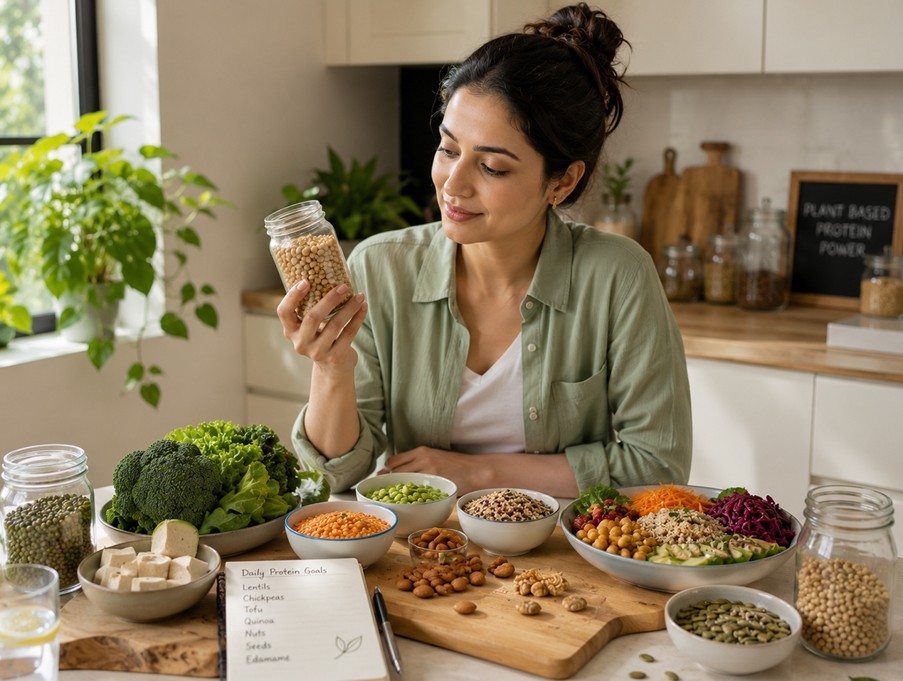
Whole foods beat processed meat analogues almost every time. Here’s what earns its spot on the plate:
- Lentils: about 18g per cooked cup
- Tofu and tempeh: 15–20g per serving
- Edamame: around 17g per cup
- Chickpeas and black beans: 14–15g per cup
- Quinoa: 8g per cooked cup (and it’s a complete protein)
- Nuts, seeds, hemp hearts: 5–10g per handful
According to the American Heart Association, legumes alone can deliver about 16g of protein per cup. Add them to almost anything and watch your numbers climb. Looking for protein diet Indian food options? Dal, rajma, chole, and paneer (if you include dairy) are powerhouse choices that fit beautifully into a plant-based protein diet.
Do You Really Need “Complete” Proteins at Every Meal?
Short answer: no. The old idea that you must pair rice and beans in the same bite is outdated. Your body pools amino acids across the day. Eat a varied plant-based protein diet and you’ll cover all your essential amino acids without a spreadsheet.
Soy, quinoa, buckwheat, and hemp are already complete proteins on their own. Bonus.
Spread It Out Across the Day
Dumping 80g of protein into dinner isn’t optimal. Your muscles use protein better when you spread intake across meals—roughly 20–30g per sitting. Breakfast counts too. A tofu scramble or a chia-loaded smoothie beats plain toast every single time. For protein diet Indian food lovers, a moong dal cheela at breakfast or a quinoa upma works wonders.
Common Myths Worth Killing
Debunking Plant Protein Misconceptions
Myth: too much plant protein damages kidneys. A nutritional literature review found no detrimental effects from high plant-based protein intake in healthy adults. Myth: you can’t build muscle without whey. Tell that to plant-based athletes stacking podiums. Myth: plant protein is “incomplete.” Variety solves it. Done.
The Bottom Line
A plant-based protein diet can meet—and often exceed—every gram your body needs. Aim for at least 1.0 g/kg if you’re eating mostly plants, bump it to 1.2–1.6 g/kg if you’re older or active, and go higher if you’re chasing performance goals. Spread your intake, lean on whole foods like lentils, tofu, tempeh, and quinoa, and stop stressing about protein combining at every meal. Real talk: most people who track their intake for a week are surprised they’re either hitting the mark or just a small tweak away.
Need a plan tailored to your body, your goals, and your kitchen? That’s exactly what we help with at Anupama—turning protein math into meals you’ll actually look forward to eating.
Frequently Asked Questions
How much protein do I need daily on a plant-based diet?
Most plant-based eaters should aim for at least 1.0 g/kg of body weight daily. Active individuals and older adults may need 1.2–1.6 g/kg, while athletes may require 1.6–2.0 g/kg to support training and recovery.
Can I get enough protein without eating meat?
Absolutely. A well-planned plant-based protein diet using lentils, beans, tofu, tempeh, quinoa, and nuts can easily meet your daily protein requirements. Many plant-based athletes and bodybuilders thrive without any animal products.
Do I need to eat complete proteins at every meal?
No. Your body pools amino acids throughout the day, so eating a variety of plant proteins across meals naturally provides all essential amino acids. Foods like soy, quinoa, and hemp are already complete proteins on their own.
What are the best high-protein plant foods?
Top choices include lentils (18g per cup), tofu and tempeh (15–20g per serving), edamame (17g per cup), chickpeas and black beans (14–15g per cup), and quinoa (8g per cup). Combining these throughout the day makes hitting your target easy.
Is plant protein harder to digest than animal protein?
Plant proteins can be slightly less digestible than animal sources, which is why recommendations suggest aiming for 1.0 g/kg instead of the standard 0.8 g/kg RDA. This small adjustment easily compensates for any digestibility differences.
Not sure where to start?
Take the 7 day Nutri Trial and see what a plan built around your own kitchen actually feels like.
Start your trial